
Blog
The power of images to trigger behaviour
6 min read
Estimated reading time
Thom Noble and Darren Bridger
Author
2026-09-17
Published
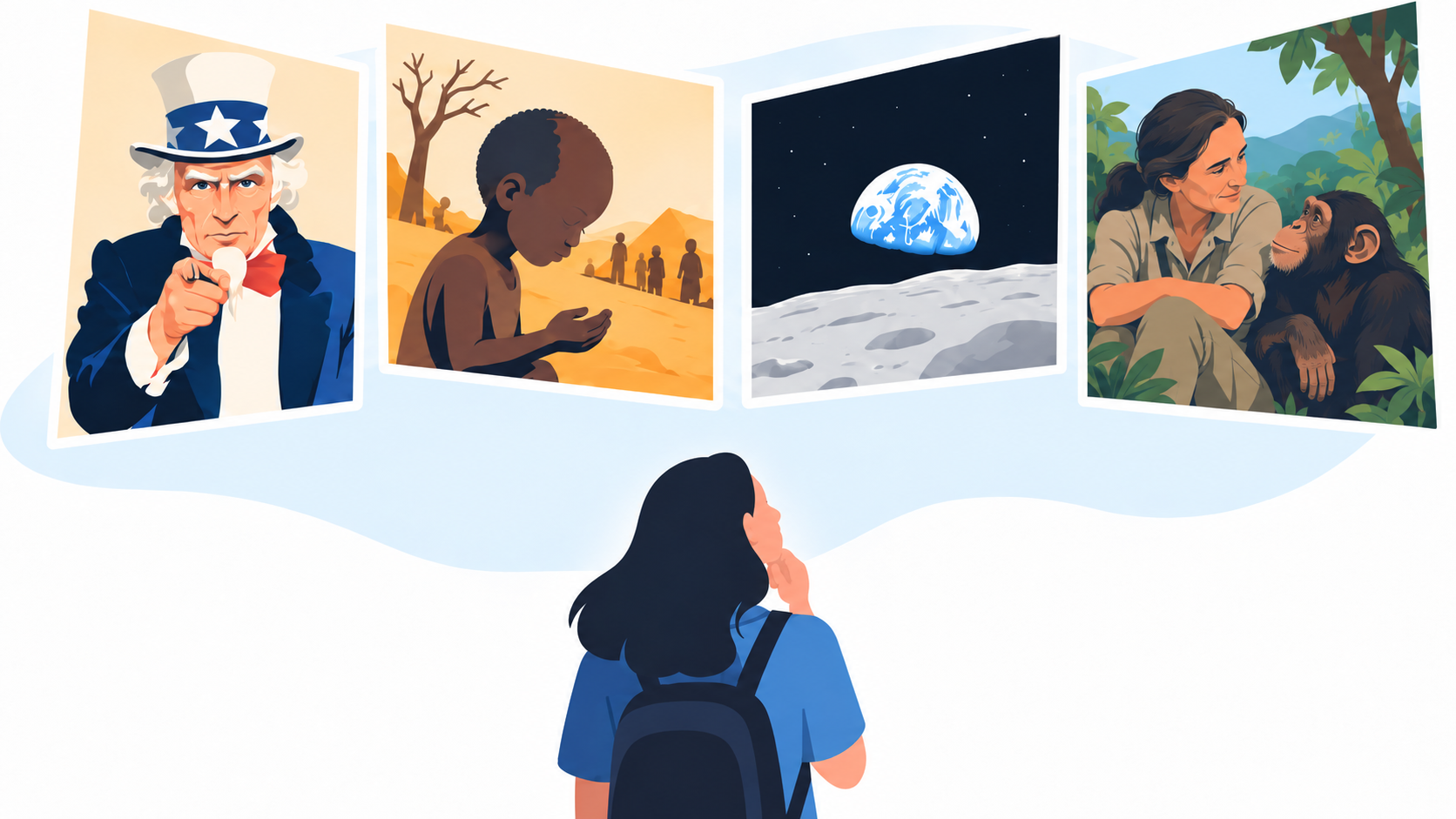
You have almost certainly changed your behaviour because of a picture. Perhaps you slowed down for a sign, put a coin in a tin, or left a product on the shelf because the pack put you off. None of those decisions took more than a second or two.
The same thing happens at a much larger scale. A few images are famous for it, and their effects played out across whole countries. Others are less well known but have been tested in controlled experiments, so we know rather more about why they worked. Put the two together and you start to see what it is about a design that gets people to act.
One of the clearest examples comes from cigarette packaging. In a randomised trial involving more than 2,000 smokers, people received packs carrying either text warnings or large pictorial warnings. Forty per cent of those receiving the pictures attempted to quit during the four-week study, compared with 34 per cent receiving text-only warnings.[1] The images appear to work partly because they make consequences concrete and evoke emotion.
Visual design can also work through feedback and comparison. OPOWER Home Energy Reports showed households how their electricity use compared with similar neighbours. Randomised field experiments involving around 600,000 treatment and control households reduced energy consumption by about 2 per cent on average.[2] Roadside speed displays use a related principle: they make the gap between the desired behaviour and your behaviour immediately visible. A US study across 22 road sites found that dynamic speed feedback and curve-warning signs reduced speeds, with effects still evident two years later.[3]
Images that made history
Some influential images are harder to study experimentally.
James Montgomery Flagg's 1917 Uncle Sam "I Want YOU" poster used direct gaze, a pointing finger and the word "YOU" to make a national message feel personal. More than four million copies were printed between 1917 and 1918.[4]
The Ethiopian famine coverage of 1984 provides another example. Michael Buerk's BBC report from the Korem relief camp was subsequently rebroadcast by 425 television stations and is estimated to have reached a global audience of 470 million people.[5] The coverage helped transform public attention to the famine and formed part of the chain of events leading to Band Aid and Live Aid. At Live Aid, a film showing Ethiopian famine victims was broadcast during David Bowie's set. People involved in the event later recalled a marked rise in donations after it aired.[6]
Then there is Earthrise. Taken by Apollo 8 astronaut Bill Anders in 1968, it showed Earth above the barren lunar landscape. NASA describes it as having helped inspire the first Earth Day in 1970.[7] Apollo 17's later Blue Marble reinforced a similar idea: Earth as one isolated ecosystem in space.[8] We cannot prove that these images caused particular behaviours, but they show how a powerful visual can change the frame through which people understand an issue.
The science of influencing behaviour
Advertising, marketing and communications have spent decades building practical expertise in how visual communication affects people. Designers, researchers and strategists know how to attract attention, create emotion, build associations, simplify information and make actions feel relevant.
Increasingly, that craft draws on behavioural and cognitive science, including salience, social norms, framing, attention, fluency, memory and emotion, alongside long experience of testing communications at scale.
Most of that expertise was developed around commercial goals. But the same knowledge can be used for social good. Techniques used to make packaging stand out or advertising prompt action can also encourage people to conserve energy, donate, drive more safely, look after their health or connect with someone who is lonely.
Measuring the fast response
We know that a pack, poster or advertisement may have only a second or two to work. Asking people afterwards to explain what they thought can miss part of that rapid response.
CloudArmy's Fast Response methods are designed to measure these quick, intuitive reactions. Doing this well requires much more than simply recording how fast someone clicks. Meaningful latency data depend on precise timing, controlled stimulus presentation, carefully designed tasks, suitable response windows, practice and attention checks, and analysis that separates general response speed from the reaction to the stimulus itself.
Reaction time provides an additional measure of the accessibility or strength of an association, alongside the person's actual answer.[9] This makes it possible to examine not only whether somebody links a design with an idea, but how readily that response comes to mind.
The method also needs specialist interpretation. Faster does not automatically mean better, and response time does not directly predict behaviour. Its value comes from combining latency with the response itself and, where useful, other measures such as visual search, saliency or eye-tracking.
Can an image help make society less lonely?
CloudArmy is now applying this approach with Art for Social Change, a global movement using art to tackle major social issues, starting with loneliness.[10]
This is much more than a poster competition. It brings together creative participation, behavioural science, advertising and communications expertise, public testing and human judgement in a first-of-its-kind model. Nearly 500 artworks have been submitted from across the UK, including work by children. CloudArmy is testing them, using our scientific and tech expertise, for their ability to capture attention, make people care about loneliness and motivate action.
The strongest work will then progress to human judges, including people with a lifetime of experience creating, evaluating and shaping communications that move people. The wider Art for Social Change team brings together senior figures from advertising, behavioural science, media, research, education and the arts.[10]
The winning work is planned to appear as posters and digital advertising in early 2027. If the model succeeds, its value goes beyond one campaign. It shows how the creative power and behavioural expertise of the communications industry can be combined with scientific testing and directed towards social problems.
An image can be beautiful, memorable or widely liked without changing anything. But an image that actually changes what someone does is altogether more powerful. We now have better tools for understanding which images can achieve that, and an opportunity to use them for more than selling products.
References
[1] Brewer, N.T., Hall, M.G., Noar, S.M. et al. (2016). Effect of Pictorial Cigarette Pack Warnings on Changes in Smoking Behavior: A Randomized Clinical Trial. JAMA Internal Medicine, 176(7), 905-912.
URL: https://jamanetwork.com/journals/jamainternalmedicine/fullarticle/2526671
[2] Allcott, H. (2011). Social Norms and Energy Conservation. Journal of Public Economics, 95(9-10), 1082-1095.
URL: https://ideas.repec.org/a/eee/pubeco/v95y2011i9-10p1082-1095.html
[3] Hallmark, S., Hawkins, N. & Smadi, O. (2015). Evaluation of Dynamic Speed Feedback Signs on Curves: A National Demonstration Project. Federal Highway Administration, FHWA-HRT-14-020.
URL: https://www.fhwa.dot.gov/publications/research/safety/14020/001.cfm
[4] Library of Congress. I Want You: Raising an Army.
URL: https://www.loc.gov/exhibitions/world-war-i-american-experiences/about-this-exhibition/over-here/raising-an-army/i-want-you/
[5] Bradley, M. (2023). Drought and Famine in Ethiopia, 1983-1985. In The Politics and Everyday Practice of International Humanitarianism. Oxford University Press. See also Franks, S. (2014), Ethiopian famine: how landmark BBC report influenced modern coverage.
And
Götz, N., Brewis, G. and Werther, S. (2020). Humanitarianism in the Modern World: The Moral Economy of Famine Relief. Cambridge: Cambridge University Press.
[6] Goldsmith, H., recollection quoted by David Bowie Official (2025). Live Aid at Wembley 40th Anniversary.
URL: https://www.davidbowie.com/blog/2025/7/13/live-aid-at-wembley-40th-anniversary
[7] NASA (2026). Advancing Earth Observation at NASA Since Release of Earthrise Photo.
URL: https://science.nasa.gov/earth/advancing-earth-observation-at-nasa-since-release-of-earthrise-photo/
[8] NASA Earth Observatory. History of the Blue Marble.
URL: https://science.nasa.gov/earth/earth-observatory/history-of-the-blue-marble/
[9] Bridger, D. (2020). Response latency measures in questionnaires: A brief overview. Applied Marketing Analytics, 6(2), pp.111-118.
URL: https://doi.org/10.69554/MPDH9797
[10] Art for Social Change. Current Mission, The Vision and The Change Team.
URLs:
https://www.artforsocialchange.org.uk/current-mission
https://www.artforsocialchange.org.uk/the-vision
https://www.artforsocialchange.org.uk/the-change-team
Related posts
Continue reading
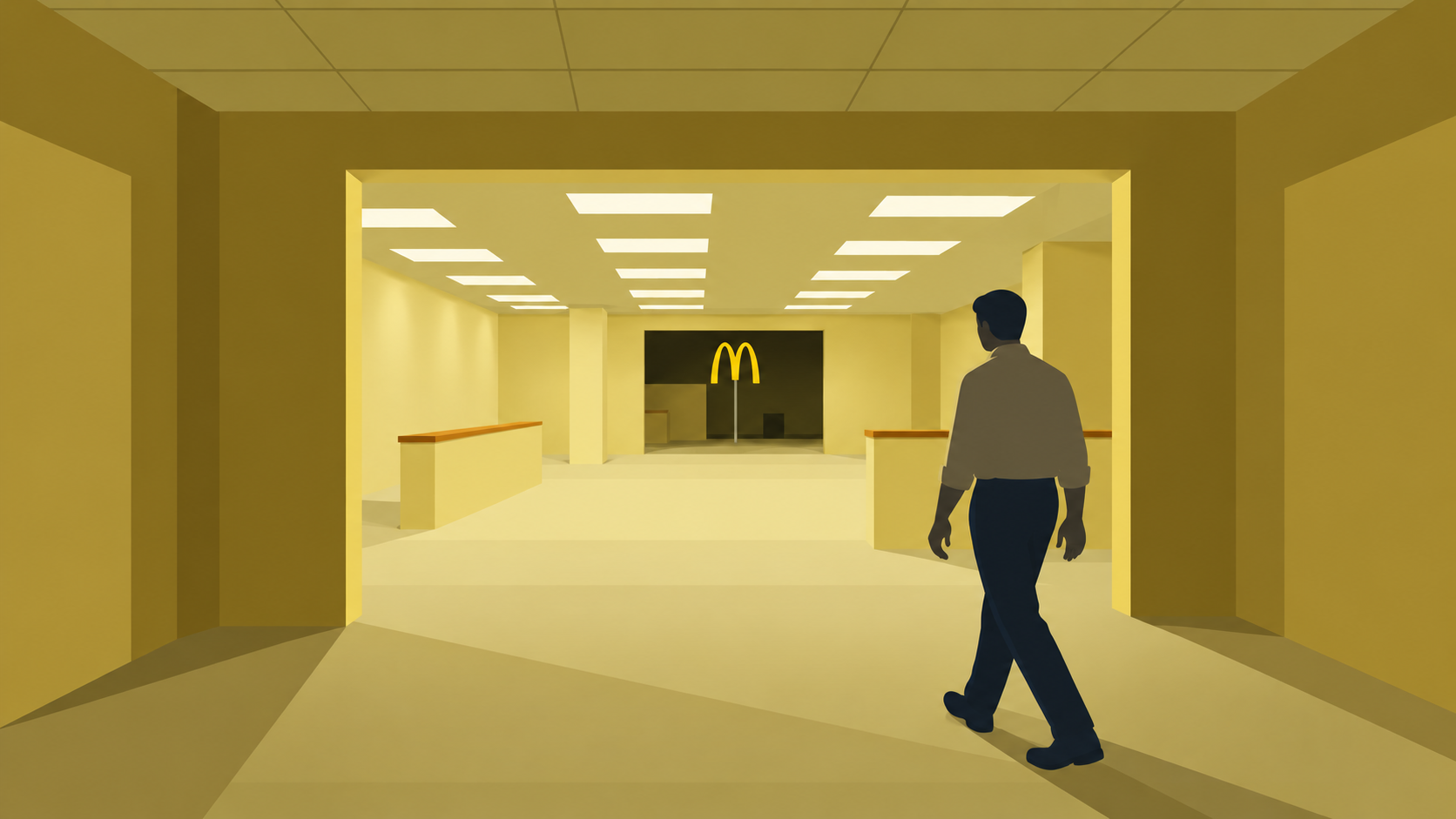
Darren Bridger explores what liminal spaces and Backrooms can teach marketers about familiarity, curiosity, nostalgia and implicit associations.
Darren Bridger · 2026-10-27
Read more
Sonic logos give brands a distinctive route into recognition and emotion. The strongest are simple, meaningful and reinforced through consistent use.
Sas Thompson · 2026-09-08
Read more
The choices that drive purchases are made quickly and mostly outside awareness. The smartest research measures those first few seconds.
Darren Bridger · 2026-05-03
Read more