
Blog
What can marketers learn from Backrooms?
6 min read
Estimated reading time
Darren Bridger
Author
2026-10-27
Published
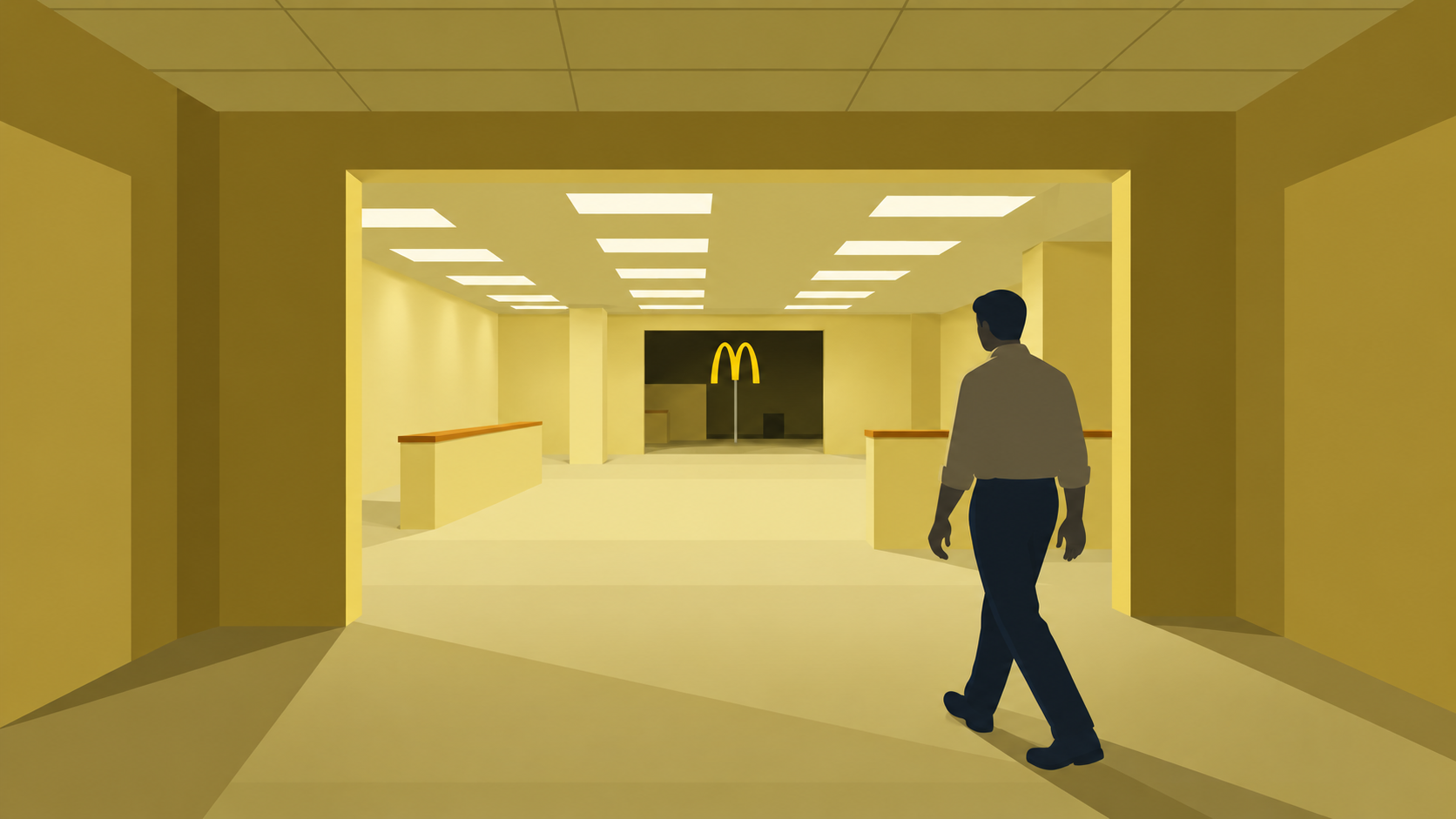
Have you seen Backrooms? It’s one of the breakout movies of 2026. I saw it and thought it was effective at conveying that strange and mysterious feeling of something that looks familiar yet also alien. I also think its popularity could point to an interesting, little-recognised emotion that marketers should think about. But even if you haven’t seen the movie, you’ll probably recognise the kinds of places it depicts: empty buildings or rooms that have an uncanny vibe, with something surreal or ‘off’ about them. Online, these settings are often called ‘liminal spaces’. They have an ‘in-between’ quality, as though caught between everyday life and a dream: recognisable places that feel eerily empty, oddly dated or subtly distorted.
One of the opportunities of the web is that it gives a name to feelings we have had but struggled to describe. There is a popular Facebook group with over 750,000 members where people post their own photos of liminal spaces. The Backrooms began as an image and a short piece of creepy internet fiction in 2019. Teenager Kane Parsons later developed the idea into a series of YouTube videos, before being hired to turn his version of it into a movie (1). For brands and marketers, that organic growth is a useful signal of interest. People had already chosen to watch and build on the idea before the film industry got involved.
The Backrooms are, in case you are unfamiliar, a labyrinth of almost empty, windowless office rooms that seem to go on forever. They generate the feeling that if you explore for long enough, something disturbing might be waiting around the next corner. With no windows to connect you to the outside world, you can lose your sense of place and time, much as in some shopping malls and casinos.
Other forms of entertainment have also toyed with similar feelings. The Apple TV series Severance and the video games Dreamcore and The Exit 8 suggest there is commercial demand for these experiences. The Exit 8 has even inspired a film, a novel and a manga. It’s fertile ground for creepy entertainment: something that attracts us yet makes us feel uneasy. The feeling is not necessarily unpleasant. It can often be more dreamlike.
So why do liminal places like the Backrooms generate these feelings in us? There are several psychological forces that could explain it.
In a 2022 study, researchers made computer-generated interiors feel uncanny by altering their familiar features (2). The ‘uncanny valley’ usually describes the unease caused by something that looks almost human, such as a robot or CGI face, but seems slightly wrong. The researchers produced a similar effect with rooms by removing expected features like furniture, doors or windows, repeating them excessively, moving them into odd positions or distorting their proportions. Interestingly, public places with distorted layouts felt more uncanny without people. Removing people from ordinary public places did not produce a clear effect.
Another angle is that of curiosity. Liminal places evoke a sense of mystery: where have all the people gone? Why does this place feel so unusual? It may also be that liminal images grab attention because they are weird and incongruous. The thought is: this doesn’t quite make sense; I’d better pay attention to it. It can feel like a puzzle to be solved.
Equally, these kinds of images can evoke nostalgia. Often they contain styles and details that remind us of the past. Although they do so in a sometimes unsettling way, this can also feel comforting or amusing, or create a personal connection, like a shared memory.
Brands have always borrowed from the visual trends of pop culture, so are there any lessons here for marketers?
Some brands have already capitalised on the popularity of Backrooms. In 2026, McDonald’s produced a promotional video called ‘You’ve Been Here Before’ (3), in which an explorer discovered a deserted McDonald’s restaurant inside them. Gucci, IKEA and Revolut have also used imagery that evokes liminal feelings (4, 5).
These kinds of campaigns seem well suited to Halloween. Familiar brand features in an unfamiliar setting can give people something to recognise and a reason to look twice. The question is whether that curiosity leaves them with the right feeling about the brand. Testing a few versions can help establish whether the brand comes across as intriguing or simply cold and unwelcoming.
The idea of being ‘in between’ also suggests opportunities beyond spooky imagery. Liminal times themselves may be an overlooked part of consumers’ lives. These in-between times can be a good opportunity for brands and marketers, and they don’t have to feel creepy. For example, brands already recognise the distinctive psychology, tastes and needs of transition periods such as adolescence. What other periods of transition are there, and what needs might people have as they move home, change career or approach retirement? More mundanely, there are the liminal moments during our daily lives, when we are travelling or waiting in queues. These can be rare chances to pause, when a brand might offer something useful or entertaining.
Another way brands can use liminality is to offer an escape from it. Backrooms and Severance capture the worst of corporate environments that can feel soulless and impersonal. Revolut used this kind of imagery in its ‘Build It Better’ campaign to convey the anxiety of navigating confusing financial systems, and then presented itself as a way out (5). Here, the unsettling atmosphere helped explain the problem the brand claimed to solve.
Perhaps the most useful lesson is to notice where familiarity starts to feel strange. That could give a Halloween campaign its appeal, or reveal something uncomfortable about a customer’s experience. For marketers, it’s worth asking where people feel lost, stuck or unsure what happens next, or when a fun retro look crosses the line into feeling creepily dated. A little mystery can make an advert interesting. Testing ads and imagery with methods such as CloudArmy’s Implicit testing can help reveal the associations they evoke and flag unintended responses. Even in the ‘backrooms,’ it helps to know where you’re taking your audience.
References
(1) From Meme to Movie: How Kane Parsons Brought the Backrooms to the Silver Screen. Vanity Fair. (https://www.vanityfair.com/hollywood/story/kane-parsons-backrooms-a24)
(2) Diel, A. and Lewis, M., 2022. Structural deviations drive an uncanny valley of physical places. Journal of Environmental Psychology, 82, p.101844. (https://doi.org/10.1016/j.jenvp.2022.101844)
(3) You’ve Been Here Before: McDonald’s. (https://youtu.be/b1m_Quu1YZw)
(4) Gucci Fall 2023 Ad Campaign. The Impression. (https://theimpression.com/gucci-fall-2023-ad-campaign-review-1/)
(5) Revolut’s Backrooms Inspired Spots Break Customers Out of Financial Anxiety. Little Black Book. (https://lbbonline.com/news/Anomaly-Leigh-Powis-Backrooms-Revolut)
Related posts
Continue reading
You have almost certainly changed your behaviour because of a picture. Perhaps you slowed down for a sign, put a coin in a tin, or left a product on the shelf because the pack put you off. None of those decisions took more than a second or two.
Thom Noble and Darren Bridger · 2026-09-17
Read more
Sonic logos give brands a distinctive route into recognition and emotion. The strongest are simple, meaningful and reinforced through consistent use.
Sas Thompson · 2026-09-08
Read more
The choices that drive purchases are made quickly and mostly outside awareness. The smartest research measures those first few seconds.
Darren Bridger · 2026-05-03
Read more